Henry Flagler’s name is so embedded in Palm Beach County that it can begin to feel like civic wallpaper.
There is Flagler Drive, the Flagler Memorial Bridge, the Flagler Museum and, farther north, an entire county bearing his name. The repetition eventually raises a reasonable question: who exactly was Henry Flagler, and why does so much of South Florida seem to carry his fingerprints?
The answer begins far from Palm Beach.
Before Florida, Flagler was one of the men who built Standard Oil, the industrial behemoth that made John D. Rockefeller synonymous with American wealth. By the time Flagler turned his attention south, he had both the money and the particular Gilded Age conviction that places could be improved by rebuilding them to suit an idea.
Palm Beach became one of his most ambitious.
A Resort Needed a Railroad
When Flagler arrived in the Lake Worth area in the early 1890s, Palm Beach already existed. There were settlers, small hotels, businesses and a community around the lake. What did not yet exist was Palm Beach as a national winter resort.
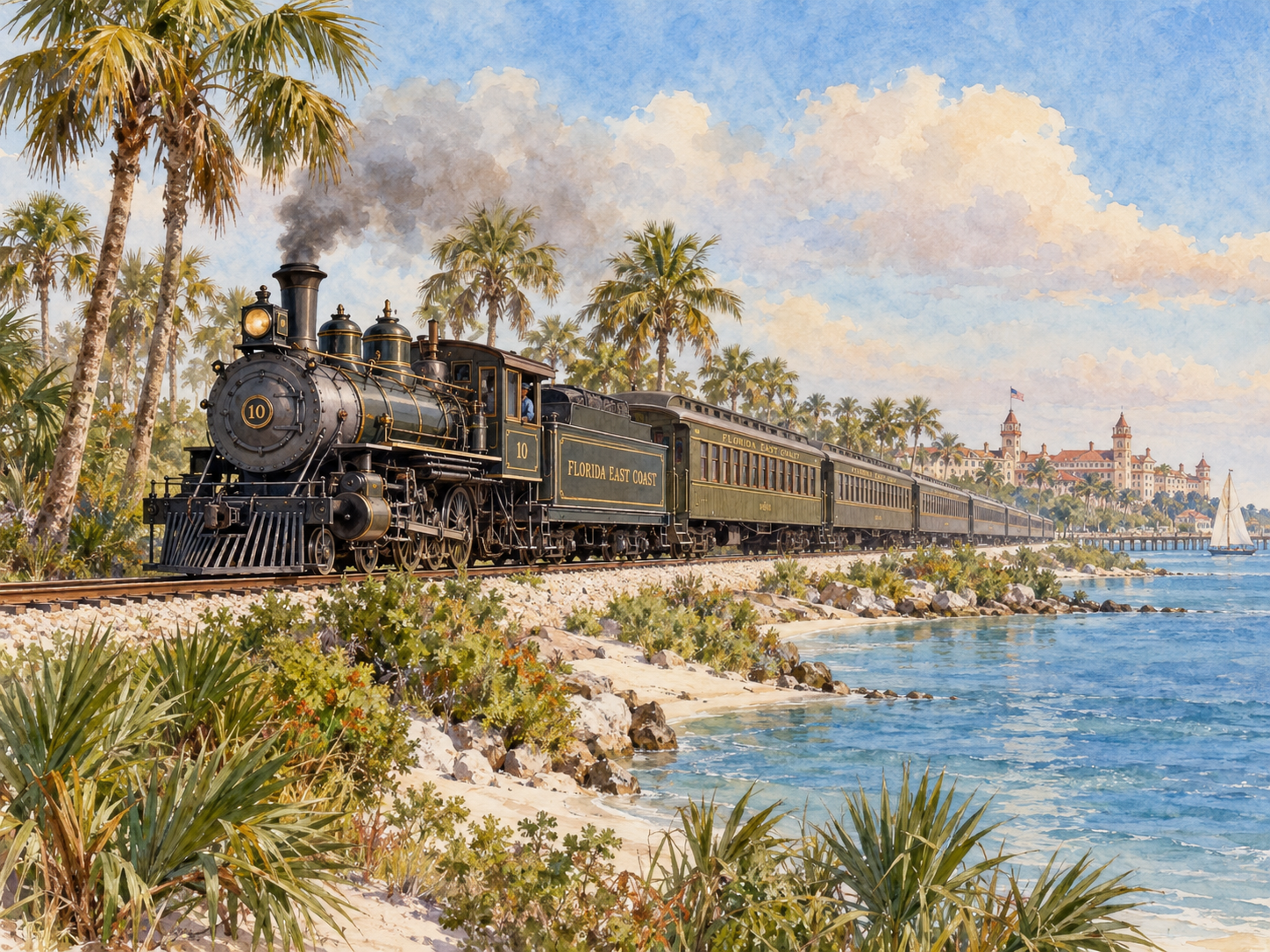
Flagler understood that a grand hotel in a remote corner of Florida would be of limited use if wealthy Northerners could not reach it comfortably. His solution was wonderfully circular: build the railroad to deliver guests to the hotel, then build the hotel to give people a reason to ride the railroad.
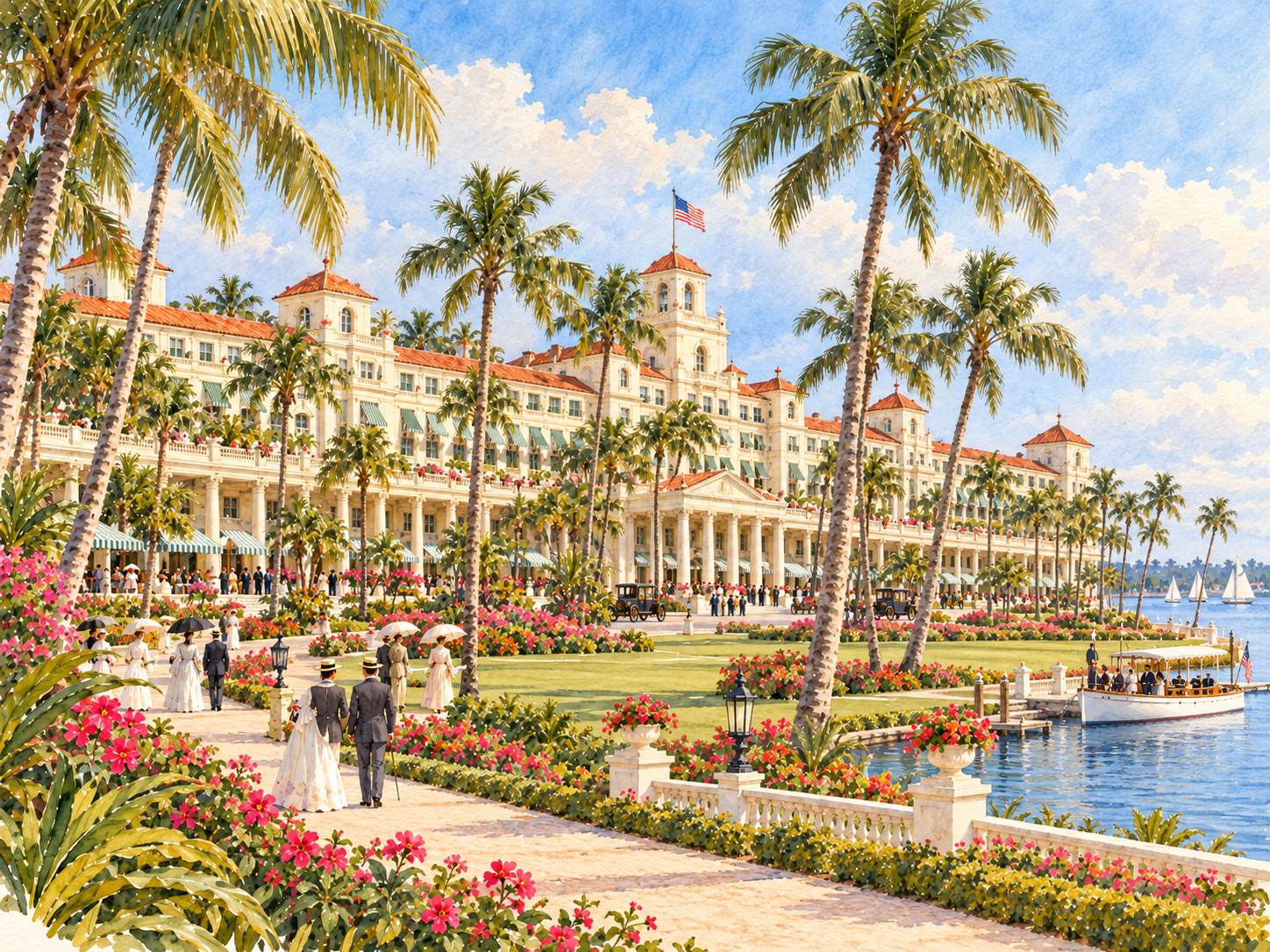
In 1894, the Royal Poinciana opened on the Lake Worth side of Palm Beach. It eventually grew into an enormous wooden resort, one of the largest hotels of its era. Two years later, Flagler opened the Palm Beach Inn on the Atlantic side of the island. Guests began referring to it as the hotel “by the breakers,” and the name stuck.
The Breakers remains. The Royal Poinciana does not.
Still, the geography of modern Palm Beach makes considerably more sense once the vanished hotel is put back into the picture. Guests once arrived by rail directly beside the Royal Poinciana, accompanied, according to local histories, by an orchestra greeting the train. A small railway later carried guests across the island toward The Breakers.
Palm Beach was not simply offering sunshine. It was manufacturing an experience.
The City Across the Water
There was one problem with creating an island playground for wealthy visitors: somebody had to build it, staff it, supply it and keep it running.
Flagler’s answer sat across Lake Worth.
West Palm Beach was laid out in 1893 as a residential and commercial town to support the resort on the island. Workers, merchants and businesses could live on the mainland while Palm Beach remained oriented toward its hotel guests and increasingly affluent residents.
The arrangement established a relationship that is still visible today. Palm Beach and West Palm Beach face one another across the water but developed with very different purposes.
One was being fashioned as a resort.
The other was being built to make the resort possible.
The People Behind the Grandeur
The polished version of the Flagler story is easy to photograph: marble halls, sweeping staircases, grand hotels and private railcars.
The labor that produced them is less visible.
Large numbers of Black workers came to the area from elsewhere in Florida, other Southern states and the Caribbean to construct the railroad and Flagler’s hotels and later to work in them. Under the segregation of the period, many lived in a community on Palm Beach known as the Styx, centered near what is now Sunset Avenue and North County Road.
The Styx was not simply a collection of workers’ quarters. Residents established homes, churches, businesses and social life there. Yet they lived on land they generally did not own, at a moment when Palm Beach real estate was becoming increasingly valuable.
By the early twentieth century, much of that land was acquired for redevelopment, including by Edward R. Bradley, whose Beach Club casino sat nearby. The Styx gradually disappeared, and by 1912 its remaining residents had been required to relocate. Many moved across the water into Black communities in West Palm Beach, including Pleasant City and the Northwest neighborhood.
Whitehall and the World Flagler Built
In 1902, Flagler completed Whitehall, the 75-room winter home he built for his third wife, Mary Lily Kenan. Today it is the Flagler Museum, and it may be the best place to understand the confidence of the era that produced modern Palm Beach.
Whitehall is not restrained and was never meant to be.
Its marble, gilding and European references announce wealth before anyone has time to inquire about it. Yet the house is more interesting when viewed not simply as a mansion but as part of a larger system. Outside its doors were Flagler’s hotels, his railway and the new towns, businesses and infrastructure that grew around them.
He had not merely built a house in Palm Beach.
He had helped build the machinery that made Palm Beach possible.
The Palm Beach That Followed
Flagler died in 1913, but by then the essential framework was in place. Wealthy Northerners had a comfortable way to reach South Florida, grand hotels waiting when they arrived and a winter social world beginning to form around them.
Others would add their own layers. Addison Mizner would give Palm Beach much of its Mediterranean architectural vocabulary. Clubs, estates and Worth Avenue would further define its social identity. Figures such as E.R. Bradley would introduce their own forms of diversion.
But Flagler had established the premise.
Palm Beach could be a place people traveled south to inhabit for a few months each year, bringing with them money, habits, social expectations and an appetite for spectacle.
In other words, he helped create Season.
More than a century later, the railroad no longer pulls directly beside the Royal Poinciana and Flagler’s enormous wooden hotel is gone. Yet stand near Whitehall, cross the Flagler Memorial Bridge or look across Lake Worth toward West Palm Beach and the original design remains surprisingly legible.
Palm Beach did not simply emerge.
It was made.
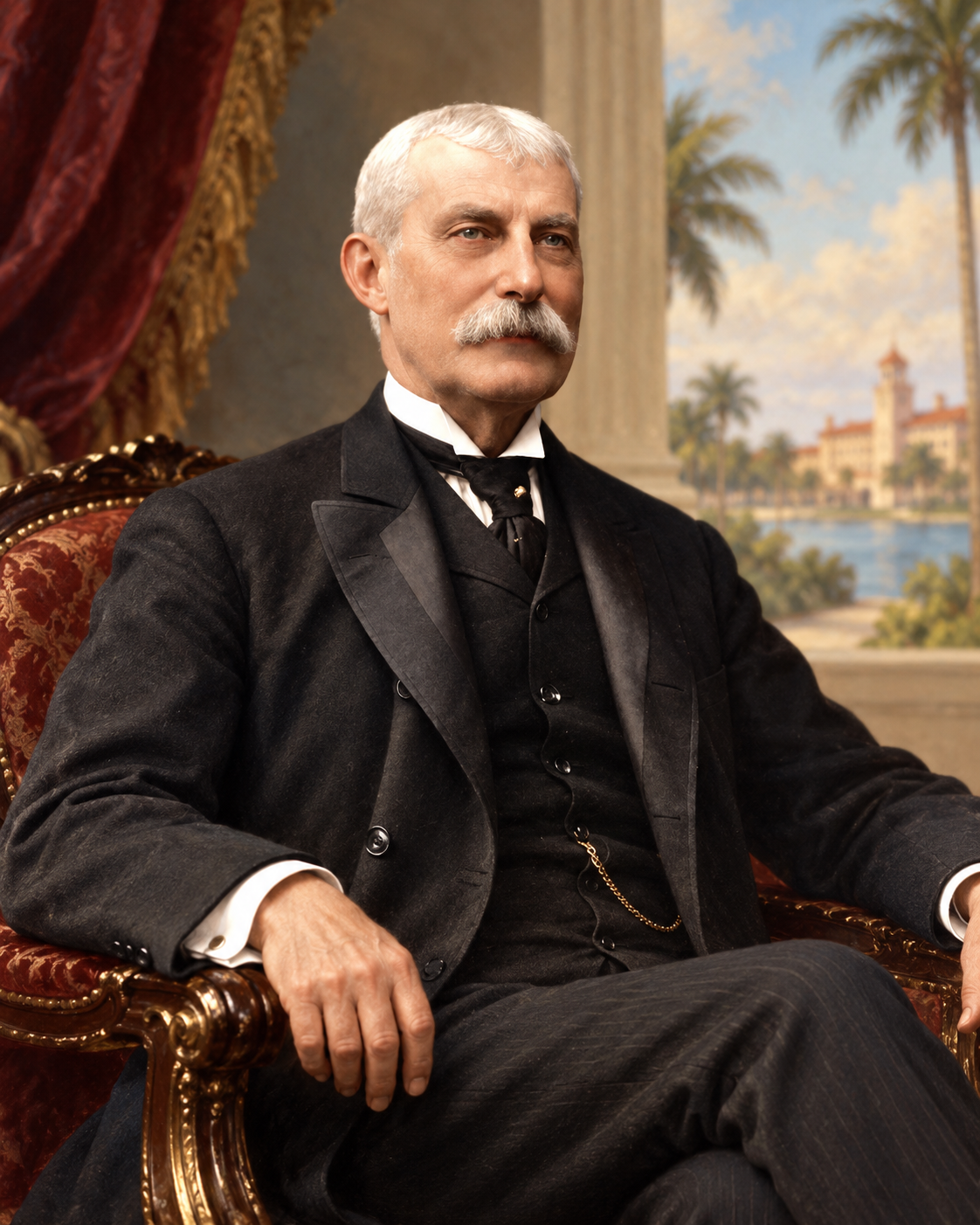
Historical illustrations in this story were generated with AI as artistic interpretations from the period. They are not archival photographs.